
La nueva era de la movilidad autónoma: ingeniería mecánica y diseño industrial
DOI:
https://doi.org/10.20983/cienciavital.2026.03.apl.02Palabras clave:
Robots autónomos de entrega, Suspensión modular, Diseño industrial, Diseño mecánico adaptable, Experiencia del usuario, Integración forma-función, Ingeniería mecánica, Movilidad urbana inteligenteResumen
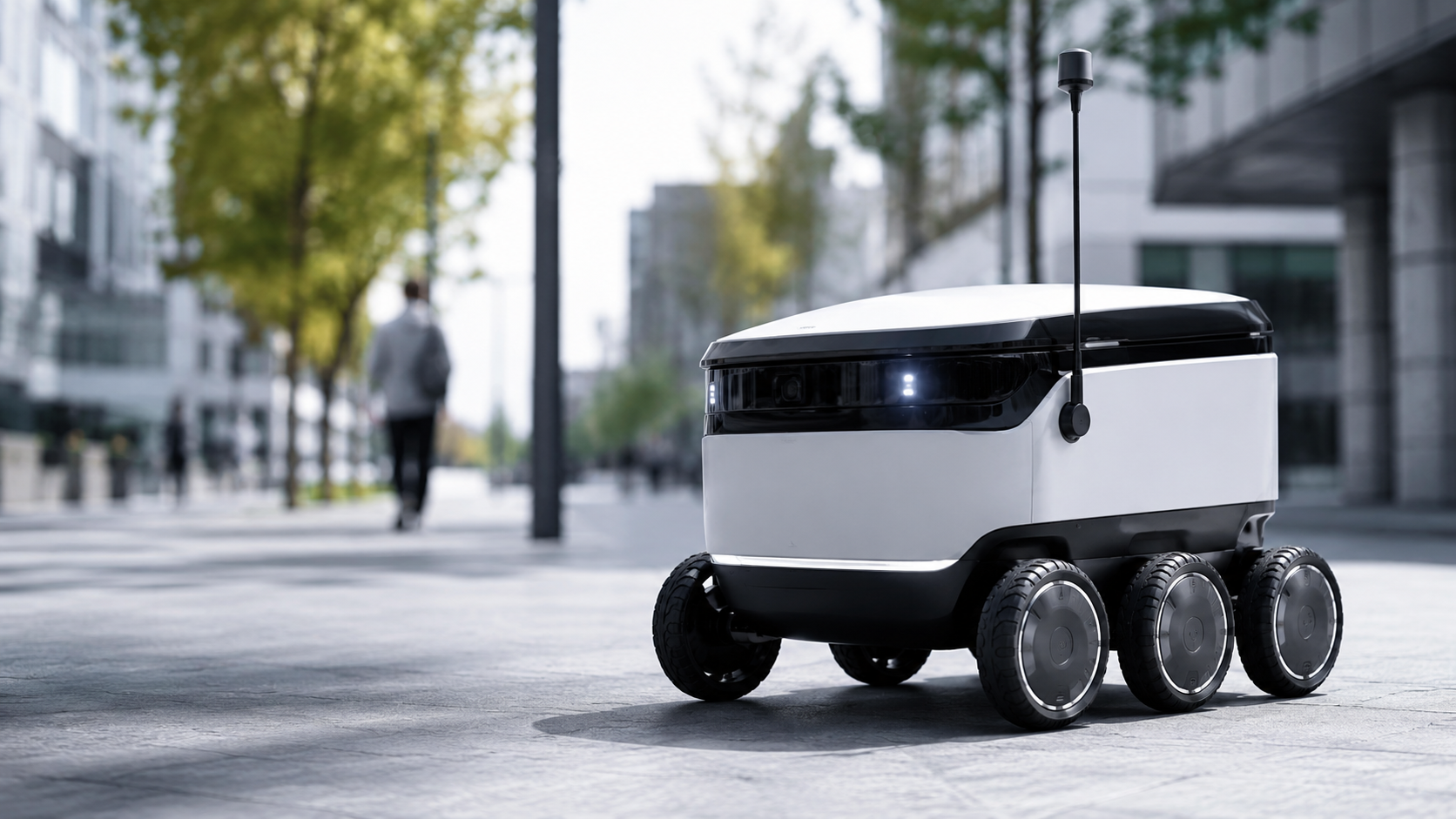
Los robots de entrega ya no son una idea futurista: circulan entre peatones, esquivan baches y transportan pedidos en silencio. Detrás de esa aparente simplicidad se esconde una compleja unión entre la ingeniería mecánica y el diseño estético. Este texto explica cómo la suspensión, tradicionalmente vista como un componente técnico, se convierte en un puente entre funcionalidad y estética.
Citas
Ş. İmre, D. Çelebi y F. Koca, “Understanding barriers and enablers of electric vehicles in urban freight transport: Addressing stakeholder needs in Turkey,” Sustainable Cities and Society, vol. 68, 2021, doi: https://doi.org/10.1016/j.scs.2021.102794.
Y. Su, H. Ghaderi y H. Dia, “The role of traffic simulation in shaping effective and sustainable innovative urban delivery interventions,” EURO Journal on Transportation and Logistics, vol. 13, 2024, doi: https://doi.org/10.1016/j.ejtl.2024.100130.
E. Ayyildiz y M. Erdogan, “Addressing the challenges of using autonomous robots for last-mile delivery,” Computers & Industrial Engineering, vol. 190, 2024, doi: https://doi.org/10.1016/j.cie.2024.110096.
J. El Ouadi, N. Malhene, S. Benhadou y H. Medromi, “Shared public transport within a physical internet framework: Reviews, conceptualization and expected challenges under COVID-19 pandemic,” IATSS Research, vol. 45, 2021, doi: https://doi.org/10.1016/j.iatssr.2021.03.001.
L. Jiang, J. Yan, Y. Xie y J. Dong, “Customers’ reuse intention to autonomous delivery vehicles in terminal delivery service: A valence theory perspective,” Journal of Retailing and Consumer Services, vol. 82, 2025, doi: https://doi.org/10.1016/j.jretconser.2024.104150.
C. Chen, J. Lin, B. You, J. Li y B. Gao, “Hexapod robot motion planning investigation under the influence of multi-dimensional terrain features,” Frontiers in Neurorobotics, vol. 19, 2025, doi: https://doi.org/10.3389/fnbot.2025.1605938.
M. H. Korayem y H. R. Adriani, “Pursuing a target by wheel-legged mobile robot using NMPC while optimizing obstacles passing,” ISA Transactions, vol. 158, 2025, doi: https://doi.org/10.1016/j.isatra.2024.12.035.
U. S. P. Srinivas Aditya, R. Singh, P. K. Singh y A. Kalla, “A Survey on Blockchain in Robotics: Issues, Opportunities, Challenges and Future Directions,” Journal of Network and Computer Applications, vol. 196, 2021, doi: https://doi.org/10.1016/j.jnca.2021.103245.
M. Watanabe, N. Michida, A. Kishi y K. Nishikawa, “Global structures of automotive interiors revealed by algorithms of the visual brain,” Design Studies, vol. 62, 2019, doi: https://doi.org/10.1016/j.destud.2018.10.004.
P. Wang, X. Liu y A. Song, “Actuation and Locomotion of Miniature Underwater Robots: A Survey,” Engineering, vol. 51, 2025, doi: https://doi.org/10.1016/j.eng.2024.10.022.
R. M. Grassmann, C. Shentu, T. Hamoda, P. T. Dewi y J. Burgner-Kahrs, “Open continuum robotics–one actuation module to create them all,” Frontiers in Robotics and AI, vol. 11, 2024, doi: https://doi.org/10.3389/frobt.2024.1272403.
S. Cicerone, G. Di Stefano y A. Navarra, “A structured methodology for designing distributed algorithms for mobile entities,” Information Sciences, vol. 574, 2021, doi: https://doi.org/10.1016/j.ins.2021.05.043.
A. Martin y M. R. Emami, “A fault-tolerant approach to robot teams,” Robotics and Autonomous Systems, vol. 61, 2013, doi: https://doi.org/10.1016/j.robot.2013.07.015.
S. Hauser, M. Mutlu, P.-A. Léziart, H. Khodr, A. Bernardino y A. J. Ijspeert, “Roombots extended: Challenges in the next generation of self-reconfigurable modular robots and their application in adaptive and assistive furniture,” Robotics and Autonomous Systems, vol. 127, 2020, doi: https://doi.org/10.1016/j.robot.2020.103467.
T. Cordie, J. Roberts, M. Dunbabin, R. Dungavell y T. Bandyopadhyay, “Enabling robustness to failure with modular field robots,” Frontiers in Robotics and AI, vol. 11, 2024, doi: https://doi.org/10.3389/frobt.2024.1225297.
J. Lin y F. Zhang, “Modular vehicle-based transit system for passenger and freight co-modal transportation,” Transportation Research Part C: Emerging Technologies, vol. 160, 2024, doi: https://doi.org/10.1016/j.trc.2024.104545.
Q. Fu y C. Li, “Robotic modelling of snake traversing large, smooth obstacles reveals stability benefits of body compliance,” Royal Society Open Science, vol. 7, 2020, doi: https://doi.org/10.1098/rsos.191192.
F. Xu, S. Dai, Q. Jiang y X. Wang, “Developing a climbing robot for repairing cables of cable-stayed bridges,” Automation in Construction, vol. 129, 2021, doi: https://doi.org/10.1016/j.autcon.2021.103807.
M. L. Hakim, Herianto y M. A. Muflikhun, “Next-gen strain sensors: Self-healing, ultra-sensitive, lightweight, and durable MWCNT-silicone rubber for advanced human motion tracking,” Journal of Engineering Research, 2024, doi: https://doi.org/10.1016/j.jer.2024.10.009.
A. Soleimani, “The soft computing approaches in optimising multi-objective mechanical design of a weeding robot,” Smart Agricultural Technology, vol. 9, 2024, doi: https://doi.org/10.1016/j.atech.2024.100674.
A. Soleimani, “The soft computing approaches in optimising multi-objective mechanical design of a weeding robot,” Smart Agricultural Technology, vol. 9, 2024, doi: https://doi.org/10.1016/j.atech.2024.100674.
C. Liu y L. Xie, “Formal versus casual: How do customers respond to service robots’ uniforms? The roles of service type and language style,” International Journal of Hospitality Management, vol. 114, 2023, doi: https://doi.org/10.1016/j.ijhm.2023.103566.
L.-Y. Qin, J. Z. Wen, C.-S. Chui y K.-S. Leung, “Housing design and testing of a surgical robot developed for orthopaedic surgery,” Journal of Orthopaedic Translation, vol. 5, 2016, doi: https://doi.org/10.1016/j.jot.2016.02.002.
R. Mateo Ferrús y M. Domínguez Somonte, “Design in robotics based in the voice of the customer of household robots,” Robotics and Autonomous Systems, vol. 79, 2016, doi: https://doi.org/10.1016/j.robot.2016.01.010.
L. Tagliavini, A. Botta, P. Cavallone, L. Carbonari y G. Quaglia, “On the Suspension Design of Paquitop, a Novel Service Robot for Home Assistance Applications,” Machines, vol. 9, no. 3, p. 52, 2021, doi: https://doi.org/10.3390/machines9030052.
M. B. Christiansen, A. Rafsanjani y J. Jørgensen, “Nature redux: interrogating biomorphism and soft robot aesthetics through generative AI,” Frontiers in Robotics and AI, vol. 11, 2024, doi: https://doi.org/10.3389/frobt.2024.1472051.
M. J. van der Schoor y D. Göhlich, “Integrating sustainability in the design process of urban service robots,” Frontiers in Robotics and AI, vol. 10, 2023, doi: https://doi.org/10.3389/frobt.2023.1250697.
R. Farkh, H. Marouani, K. Al Jaloud, S. Alhuwaimel, M. T. Quasim y Y. Fouad, “Intelligent Autonomous-Robot Control for Medical Applications,” Computers, Materials and Continua, vol. 68, 2021, doi: https://doi.org/10.32604/cmc.2021.015906.
C. Ohneberg et al., “Assistive robotic systems in nursing care: a scoping review,” BMC Nursing, vol. 22, 2023, doi: https://doi.org/10.1186/s12912-023-01230-y.
S. Xu, X. Zhang, R. Kim y M. Su, “Anthropomorphic last-mile robots and consumer intention: An empirical test under a theoretical framework,” Journal of Retailing and Consumer Services, vol. 81, 2024, doi: https://doi.org/10.1016/j.jretconser.2024.104028.
L. Y. Koh y K. F. Yuen, “Individual-, task-, and technology-fit perspective of autonomous delivery robots confirmation and adoption in smart cities,” International Journal of Hospitality Management, vol. 128, 2025, doi: https://doi.org/10.1016/j.ijhm.2025.104182.
Publicado
Número
Sección
Licencia
Derechos de autor 2026 Luis Arturo Melendez Valdez

Esta obra está bajo una licencia internacional Creative Commons Atribución-NoComercial-CompartirIgual 4.0.